


PUBG: Army Attack and PUBG: Exhilarating Battlefield for Android and iOS Launched in China

HIGHLIGHTS
- Tencent has released two PUBG games
- Right now they're exclusive to China
- They're for Android and iOS and have been made in Unreal Engine 4
Tencent has finally made good on its announcement of two PlayerUnknown’s Battlegrounds (PUBG) smartphone games in November. One is PUBG: Army Attack and is developed by Tencent's Timi Studio. It has naval battles (something the PC games does not have) and sports a more arcade-styled aesthetic and feel.
The other is PUBG: Exhilarating Battlefield developed by Lightspeed and Quantum Studios, another Tencent entity which mirrors the gameplay and look of the PC game closely. Both games are being made in Unreal Engine 4.
“Both games have instantly jumped to the top of the download charts on iOS. The games had 75 million pre-registrations. So that shows you how huge the demand was for PUBG on mobile,” tweeted noted games analyst Daniel Ahmad of Niko Partners.
At the moment neither game have a release date outside of China, but given the popularity of the likes of Rules of Survival, it’s just a matter of time before Tencent takes battle royale on the go internationally.
Last year Tencent was bashed by China’s media for getting children hooked on violence after the fantasy role-playing game Honour of Kings boomed in popularity, forcing it to introduce a curfew for underage players.
The company said it would highlight the spirit of teamwork and fair competition from PUBG and ensure it delivers "healthy, positive cultural and value guidance, especially for underage users".
Kingdom Come: Deliverance PS4 Day One Patch
Download Size Is 23GB

HIGHLIGHTS
- Kingdom Come: Deliverance is out on February 13
- The game has a 23GB day one patch on PS4
- It improves in-game events and combat among other things
Action role-playing game Kingdom Come: Deliverance release date is February 13, but that hasn't stopped enterprising but that hasn’t stopped game stores in the UAE from breaking street date and subsequently re-exporting copies of the game to countries like India. Gadgets 360 got its hands on the game for the PS4. Like most modern day video games, we were treated to a day one patch. And this one is on the bigger side, clocking in at 23GB. Well, 23.07GB to be exact. This takes the total file size of the game upto around 46GB.
Aside from updating the game to version 1.01 it comes with a host of improvements. These include better dialogue animations, an improved persuasion user interface, combat fixes as well as tweaks to sound. We played a bit of the game on a PS4 Pro before updating and after updating. Without spoiling much, the differences are palpable, making this update crucial. Still we can't help but feel that it will be taxing for those with lower bandwidth caps.
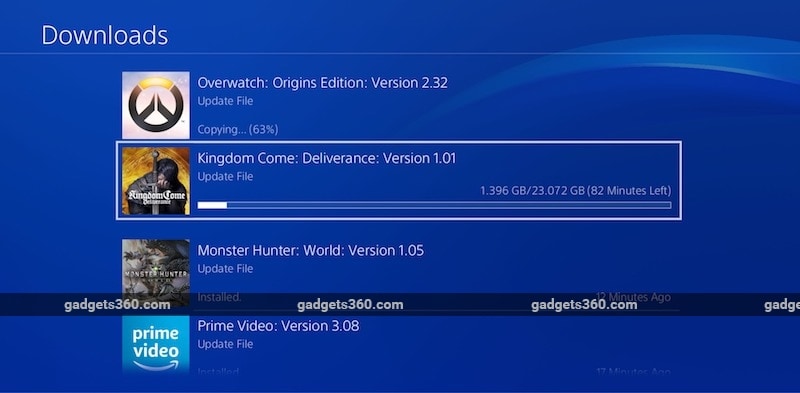
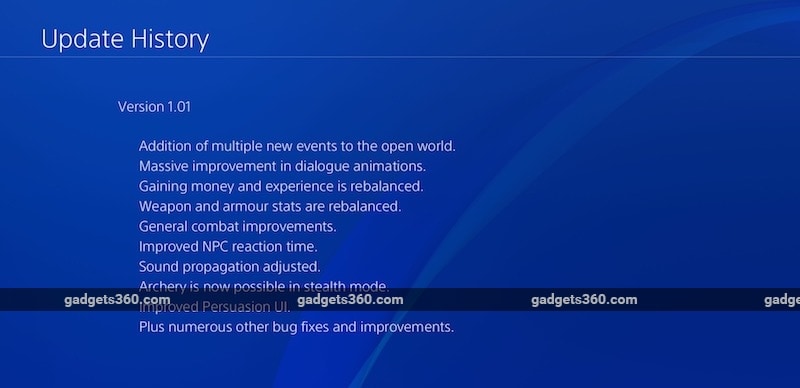
Nonetheless, the game's developer Warhorse Studios has issued a statement explaining why the game's file size is bigger than you'd expect it to be.
“Four years after our Kickstarter campaign, our game is set to be released tomorrow. The task was really big and our team although still quite small and we always wanted to deliver, to create the game we wanted and we believed you wanted. Before talking about some background, all of us at Warhorse would like to thank our community, the backers and friends who helped us to bring this dream to life by giving us the chance to develop what we believe is a unique RPG experience!," claims Martin Klima, Executive Producer at Warhorse.
"The production realities of game development mean that a ‘release’ version has to be finalized some time before the actual release date. We could have used this time to get some rest, or we could use it to create some additional content and sell it to you as DLC, but we went back to the version-to-be-released and worked on it. The results are obvious: quests are more balanced, RPG progression is smoother, the game runs faster and every facet of the game got more polish. The drawback of course is that most of the data in the old build was replaced and has to be downloaded as a patch. At a hefty size, it’s going to take some time to download and it’s a shame. Still, we strongly believe that after four years wait it will pay off to wait a little bit longer while the day one patch is downloading. Trust me, it will deliver the awesome experience you deserve!”
Furthermore, Senior Manager for Marketing and PR at the game's publisher, Deep Silver Will Powers took to popular gaming forum ResetEra to explain the nuances related to Kingdom Come: Deliverance's update size.
"So, let me stop the rumor mill dead in its tracks before everyone continues jumping to conclusions. The way that I've been told that the engine works, is it takes the entire game and separates the PKG or ISO into 2GB archives. If during a patch you so much as alter a 1KB text file within any of these 2GB archives, then you need to reupload the entire 2GB portion. That beings said, this is a major patch that improves overarching mechanics throughout the game, so it touches almost all of these 2GB archives in the entire game build. Essentially you are having to redownload the game to replace the existing files. It shouldn't stack them and inflate on your harddrive, but rather replace the previously downloaded build files," Powers' post reads.
Google Paid Out Nearly $3 Million to
Security Researchers in 2017

Tech giant Google paid out almost $3 million (roughly Rs. 19 crores) to security researchers in 2017 as rewards for the vulnerabilities they found in its products and services.
Around $1.1 million (roughly Rs. 7 crores) each was paid for bug reports specific to Google and Android products while Chrome awards accounted for the rest of the Vulnerability Reward Program.
"We awarded researchers more than $1 million for vulnerabilities they found and reported in Google products, and a similar amount for Android as well. Combined with Chrome awards, we awarded nearly $3 million to researchers for their reports," Jan Keller, a member of Google's Vulnerability Reward Program (VRP) wrote in a blog post.
"We also awarded $125,000 to over 50 security researchers from all around the world through our Vulnerability Research Grants Program and $50,000 to the hard-working folks who improve the security of open-source software as part of our Patch Rewards Program," Keller added.
The largest single payment of $112,500 (roughly Rs. 72.4 lakhs) went to independent researcher Guang Gong for outlining an exploit chain on Pixel phones as part of the Android Security Rewards Program.
The Pixel was the only device that was not exploited during last year's annual "Mobile Pwn2Own" competition and Guang's report helped strengthen its protections further.
"Pwn2Own" is a hacking contest held annually at the CanSecWest security conference where contestants are challenged to exploit widely-used software and mobile devices with previously unknown vulnerabilities.
Nest Co-Founder Matt Rogers Announces Exit
From Google

Nest co-founder Matt Rogers has announced that he is exiting the smart home company, a day after Google announced that the US-based manufacturer of home automation equipment was being reunited with the tech giant's hardware team.
Rogers said that he decided to leave the company in order to spend more time at Incite.org -- a Venture Capital (VC) firm and product development lab that he also had a hand in co-founding.
"After almost nine incredible, intense years working to build Nest, I've decided to begin my transition to dedicate more of my time to Incite.org, as well as to start thinking about the next adventure," Matt Rogers tweeted from his handle @nestmatt late on Thursday.
Nest was co-founded by Chief Product Officer Rogers in 2011 with former CEO Tony Fadell.
Google had bought the US-based start-up of home automation equipment in 2014 for $3.2 billion (roughly Rs. 20,600 crores).
Since Nest joined Google four years ago, the team has experienced incredible momentum. The company doubled its hardware portfolio last year by selling more devices in 2017 than the previous two years combined.
The departure of Rogers, Nest's last remaining co-founder, marks the close of a chapter for the company, according to CNET.
Nest is a noted name in the world of smart home devices with its eponymous thermostat and smoke detector and "Nest Cam" smart security camera products.
Nvidia's Upbeat Forecast Powered by Data Centre, Cryptocurrency Demand
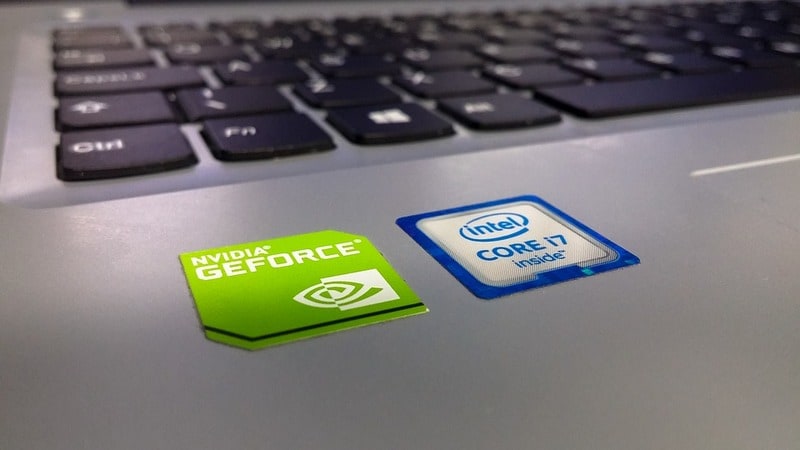
Nvidia's upbeat current-quarter revenue forecast on Thursday underscored surging demand for its graphics chips used in data centres, gaming devices and cryptocurrency mining, sending its shares up as much as 12 percent in extended trading.
The company, which also reported better-than-expected quarterly results, is reaping the benefits from the launch of its Volta chip architecture last year. Volta processors power a range of technologies such as artificial intelligence and driverless cars.
"Virtually every internet and cloud service provider has embraced our Volta GPUs," Nvidia's Chief Executive Officer Jensen Huang said in a statement.
Graphic chips were initially developed to handle graphics for high-end video games and other computers. These chips help share the processing load from the main chip, making it easier and faster to run high-end applications.
These chips are now being widely used in new technologies, like artificial intelligence, machine learning.
Revenue from Nvidia's widely watched data centre business, which counts Microsoft Corp's Azure cloud business as its customer, more than doubled to $606 million (roughly Rs. 3,900 crores).
That trounced analysts' average estimate of $541.1 million.
Nvidia also sells chips to Amazon.com's Amazon Web Services (AWS), which is duelling with Microsoft to handle data and computing for large enterprises
Data centre should continue to grow pretty nicely into calendar 2018 and beyond, Morningstar analyst Abhinav Davuluri said.
The boom in cryptocurrencies is also powering demand for chips from Nvidia and rival AMD as they provide the high computing ability required for cryptocurrency "mining."
"Strong demand in the cryptocurrency market exceeded our expectations," Chief Financial Officer Colette Kress said on a conference call.
"While the overall contribution of cryptocurrency to our business remains difficult to quantify, we believe it was a higher percentage of revenue than the prior quarter."
The company said inventory levels of its gaming GPUs throughout the quarter was lower than historical channel inventory levels due to surging demand from cryptocurrency miners.
The price of Bitcoin, the most popular cryptocurrency, rose more than 1,300 percent in 2017. Prices have, however, dropped about 40 percent this year.
Nvidia's revenue from gaming, for which it is best known, rose 29 percent to $1.74 billion (roughly Rs. 11,200 crores), accounting for a more than half of its total revenue in the fourth quarter, and also beating analysts' estimate of $1.59 billion.
The company forecast current-quarter revenue of $2.90 billion, plus or minus 2 percent, well above the analysts' average estimate of $2.47 billion, according to Thomson Reuters.
Net income rose to $1.12 billion, or $1.78 per share, in the fourth quarter ended January 28 from $655 million, or 99 cents per share, a year earlier.
Results include a $133 million gain related to the new US tax law.
Total revenue rose 34 percent to $2.91 billion, topping estimate of $2.69 billion.
Excluding items, the company said it earned $1.72 per share.
Nvidia earned $1.57 per share, excluding the tax benefit, according to Thomson Reuters, beating estimate of $1.17.
The company's shares were trading at $233 in extended trading. They have surged about 83 percent in the past 12 months
Apple HomePod Now Available in US, UK, and
Australia

HIGHLIGHTS
- Apple HomePod is now available in the US, UK, and Australia
- HomePod comes with a price tag of $349
- It is on sale through Apple's online store and various offline retailers
The much anticipated Apple HomePod is finally here. The new smart speaker, which is designed by the Cupertino giant to offer a premium sound experience with Siri integration, comes at a price of $349 (approximately Rs. 22,500), and is available for purchase in the US, UK, and Australia. Customers can place an order for the HomePod directly from Apple's online store, or purchase it from any nearby Apple Store.
Select Apple Authorised Resellers, including Best Buy in the US; Argos, Dixons Carphone (Currys PC World), John Lewis, Shop Direct (Very and Littlewoods), EE and Apple Premium Resellers in the UK; and The Good Guys, Harvey Norman, JB Hi-Fi, Myer and Telstra in Australia, have also started selling the HomePod locally. Pre-orders for the HomePod started on January 26.
Entering the smart speaker market where the likes of Amazon Echo and Google Home already operate, Apple's HomePod features proprietary audio technology that comprises a high-excursion woofer equipped with a custom-engineered amplifier, an array of seven tweeters - each of which has its own amplifier and a transducer, and six microphones. The speaker is powered by Apple A8 chip that makes it a smarter option in the town. Further, there is Siri integration to let you interact with the HomePod directly using your own voice.
Reviews have praised the incredible audio quality of the HomePod, but panned its limited Siri integration when compared to the Echo and Google Home.
The 6.8-inch tall HomePod uses an advanced algorithm that is touted to continuously analyse the music and tune the low frequencies dynamically. Also, Apple plans to bring AirPlay 2 support sometime later this year to enable a stereo sound effect when two HomePods are connected wirelessly.
Apple has provided gesture controls on the HomePod that are featured on its top panel. These controls allow you to play, pause, skip a song, or adjust the volume with a single tap, in addition to voice controls. Users can play music from Apple Music or use their iTunes Match library to stream content directly from their music library using Siri. You will need an Apple device to set up a HomePod - Apple added HomePod support for compatible iPhone, iPad, and iPod touch models through iOS 11.2.5 that was released last month.
Apart from the launch markets, Apple has revealed plans to bring the smart speaker to France and Germany this spring. There's no word on the launch in India and other markets.
Amazon Prime Subscribers in the US Get a New Benefit: Free Whole Foods Delivery in 2 Hours

Amazon is bringing its speedy delivery to Whole Foods - and Margot Good might never visit the organic grocery chain again.
"I can stay in my pajamas at home and have them deliver me my groceries," she said Thursday after learning about the new service outside a Cincinnati location.
The online retail giant plans to roll out two-hour delivery at Whole Foods this year to those who pay for Amazon's $99-a-year (roughly Rs. 6,400) Prime membership. It is the company's biggest move since it bought the organic grocer last year.
It's also precisely the action rivals have been preparing for since the day Amazon - with the Prime program that's been so successful in cementing customer loyalty - announced plans to buy Whole Foods.
Amazon shoppers can order meat, seafood and other Whole Foods grocery items through the Prime Now app and website. Deliveries started Thursday in Austin, Texas; Cincinnati; Dallas; and Virginia Beach, Virginia; and will expand nationwide this year.
While convenient, not everyone wants other people picking out their eggs or fruit. A major hurdle for companies that offer grocery delivery is getting those people to sign up, said Darren Seifer, a food and beverage industry analyst at NPD Group.
"There are always going to be people who want their bananas a little green," he said.
Ade Ogbomo, a teacher in Dallas, said she orders everything from Amazon - except food.
"I like to get it myself," she said outside a Whole Foods store. She worries about the possible mishaps: "Maybe the bananas are bruised or the cookies are all broken up, and you can't really complain because you asked for it."
Good, though, said she thinks Whole Foods has high-enough quality produce that she's not worried about choosing items herself.
About 7 percent of US households bought groceries online last year, according to NPD Group. Most of those - about three-quarters - get their orders delivered to their door; the rest pick it up at the store. NPD Group said it expects online grocery shopping to grow quickly, especially among young adults, who are more comfortable shopping online.
And grocery chains don't want to miss out when that happens.
Walmart, the country's largest grocer, is making it easier for customers to order groceries online and pick them up at the store. Target bought grocery-delivery company Shipt late last year. Kroger, the largest traditional supermarket chain, has been promoting store pickup for online orders and doing trials of home delivery.
Maggie Anderson, 38, a therapist in Cincinnati, said she has tried it at Remke, a regional chain.
"I just did my first order online at Remke this week because I was of out of town, and that was great," she said. "It saved me a whole hour and a half of time."
For Amazon, items will be pulled from Whole Foods stores, bagged and then delivered by Amazon drivers. Amazon, based in Seattle, said there's no extra fee for two-hour deliveries above $35 (roughly Rs. 2,250), but one-hour delivery will cost $8 (roughly Rs. 510). The company isn't saying where delivery will expand, but its Prime Now service is in more than 30 cities, including Chicago, Milwaukee and San Diego.
The announcement gives Amazon yet another way to get groceries to customer's doorsteps.
It already does so through AmazonFresh, but that requires a $15-a-month fee. And Prime Now delivers groceries from its facilities, but it has also offered grocery delivery from other physical stores, including Whole Foods rival Sprouts Farmers Market.
Whole Foods also offers delivery in some cities through a partnership with delivery service Instacart, which will continue.
Buying Whole Foods was the biggest part of a push into physical retail for the chain known for online shopping. Right after taking over Whole Foods, Amazon made a splash by cutting prices on bananas, yoghurt and other items. It also began selling Kindle e-readers in some of its 470 stores, and started selling Whole Foods-branded food on its site.
Xiaomi, Vivo, Oppo, Others to Use Qualcomm 5G Modem With First Devices Coming in 2019

HIGHLIGHTS
- 5G smartphones are expected from several OEMs in 2019
- Trials with network operators will begin later this year
- Speed demonstrations will be given at this year's MWC
More than a dozen global smartphone and PC OEMs have tied up with Qualcomm to incorporate the Snapdragon X50 5G NR modem on to their mobile devices. Qualcomm has said the first smartphones featuring its X50 5G NR modem will hit the market in 2019, with Chinese brand Vivo promising such a handset next year. Major mobile phone OEMs joining hands with Qualcomm to incorporate the 5Gmodem in their future smartphones include the likes of Xiaomi, Nokia brand licensee HMD Global, Sony, LG, HTC, Oppo, and ZTE.
Other OEMs that have partnered with Qualcomm are Fujitsu, Inseego/ Novatel Wireless, NetComm Wireless, Netgear, Sharp, Sierra Wireless, Telit, Wingtech, and WNC. Devices by these OEMs will be built around the sub-6GHz and millimetre wave (mmWave) spectrum bands starting next year.
Apart from smartphones, the new Snapdragon X50 5G NR modem will be available on Always Connected PCs, Head-Mounted Displays (HMDs) - including Virtual Reality (VR), Augmented Reality (AR) and Extended Reality (XR) - and Mobile Broadband. Qualcomm claims this technology will offer faster browsing, faster downloads, better streaming, and instant cloud access on phones. The modem will enable high speed and low latency for Always Connected PCs, and ultra-low latency for HMDs.
"As evidenced by our work with these distinguished OEMs from around the globe and as we demonstrated in 3G and 4G LTE, Qualcomm Technologies is utilizing our deep expertise and technology leadership to support the successful launch of 5G NR, driving innovation in the mobile ecosystem," said Alex Katouzian, Senior Vice President and General Manager, Mobile, Qualcomm Technologies.
Separately, Qualcomm has also partnered with several wireless network operators in the above mentioned sub-6GHz and millimetre wave (mmWave) bands. These include AT&T, British Telecom, Sprint, China Telecom, China Mobile, China Unicom, NTT DOCOMO, Orange, Verizon, Telstra, Singtel among others. The upcoming trials will combine Qualcomm's 5G platform and smartphone reference design with an aim to commercialise compliant 5G products later this year.
To further showcase this, planned demonstrations will be held at this year's Mobile World Congress in Barcelona. The Qualcomm booth is expected to have Snapdragon X50 modems reaching speeds of "several gigabits per second."
A HTC handset with 5G support, said to be the U12, was recently showcased at an industry event in Taiwan. The handset was shown delivering download speeds of 809.58Mbps.


No comments:
Post a Comment